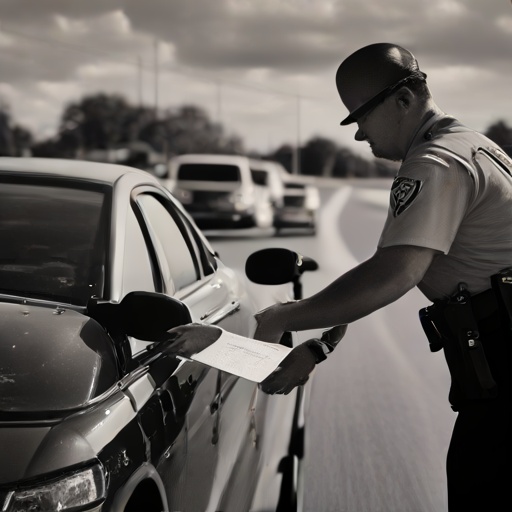
 Imagen generada con IA para Politics
Orlando Area Deputy Caught Speeding Avoids Arrest After Trooper Alters Ticket
A Florida Highway Patrol trooper clocked an off-duty Orange County deputy at 111 mph but changed the speed on the citation to avoid arresting a colleague.
A routine traffic stop in Central Florida has sparked questions about law enforcement accountability after video footage revealed a state trooper altering a speeding ticket for an off-duty sheriff’s deputy. The incident, which occurred along the I-4 corridor, highlights the complex dynamics between local and state agencies when colleagues are involved.
The Chase on Interstate 4
Florida Highway Patrol (FHP) Trooper David Smith was patrolling a stretch of interstate known for heavy tourist traffic and frequent speeding violations. According to dashcam footage released by the FHP, Smith observed a motorcycle weaving through lanes at excessive speeds. Using radar equipment, he determined the rider was traveling at 111 miles per hour in a zone where the speed limit is significantly lower.
Smith immediately initiated a pursuit. The high-speed chase ended when the motorcyclist pulled over safely on the shoulder of the highway. Upon approaching the vehicle, Smith recognized the rider as an off-duty deputy from Orange County Sheriff’s Office (OCSO). This recognition changed the trajectory of the encounter entirely.
Initially, Trooper Smith stated in his internal notes that he believed the officer was "going to jail" for reckless driving. However, once he identified the motorcyclist as a fellow law enforcement professional, the situation shifted from a standard criminal arrest to an administrative disciplinary matter between agencies.
The Altered Citation
Instead of processing the deputy for felony speeding or reckless driving, Trooper Smith issued a citation but altered the recorded speed. The original radar reading of 111 mph was crossed out and replaced with a lower figure on the physical ticket provided to the officer.
This act of altering an official document is serious. Law enforcement officers are held to strict standards regarding accuracy in their reports. By changing the speed, Smith effectively reduced the severity of the offense from a potential criminal charge to a lesser traffic violation that would be handled internally by the deputy’s agency, more context in High-Speed Chase: FHP Trooper Pursues Suspect at 140 MPH on I-75.
The video footage shows Trooper Smith writing on the ticket after initially declaring his intent to arrest the driver. The discrepancy between his verbal declaration and his written action became central to an internal investigation into whether he violated departmental protocols regarding arrests of fellow officers.
Internal Investigation and Outcome
The Florida Highway Patrol launched an inquiry into Trooper Smith’s conduct during the stop. Investigators reviewed body-worn camera footage, dashcam video, and written reports to determine if the alteration constituted misconduct or a procedural error born out of collegiality.
Ultimately, the FHP determined that while altering the ticket was technically improper, no criminal charges were filed against either party in this specific instance. The deputy faced internal disciplinary action from Orange County Sheriff’s Office for his reckless driving behavior on public roads, a story we covered in High-Speed Chase: FHP Trooper Pursues Suspect at 140 MPH on I-75.
Trooper Smith received administrative counseling regarding proper procedures when dealing with law enforcement colleagues who commit traffic violations. The department emphasized that while inter-agency cooperation is vital, the integrity of official reports must remain uncompromised regardless of the violator's badge status, Univision reported.
Impact on Central Florida Community
This incident has drawn attention from residents along the I-4 corridor and in Orlando’s growing suburbs. The visibility of law enforcement interactions is higher than ever, with citizens frequently recording police stops on smartphones. Such recordings ensure that every decision made by officers is subject to public scrutiny.
For Orange County Sheriff Scott Israel, who has previously emphasized transparency and accountability within his department, this case serves as a reminder of the challenges in maintaining strict standards across all ranks. The deputy’s actions endangered not only himself but also other motorists on one of Florida’s busiest highways.
The FHP statement noted that their officers are trained to enforce laws impartially. However, human judgment calls during high-stress situations can lead to procedural deviations like the one seen in this video. The department is reviewing its training protocols for such scenarios to ensure consistency in future encounters between state and local officers.
Local residents continue to express concern over speeding on major arteries like Interstate 4, which connects Orlando International Airport with theme parks and residential areas throughout Central Florida. Community advocates argue that strict enforcement against all violators, regardless of profession, is essential for road safety in a region dominated by tourism and heavy traffic.
As the investigation closes its administrative chapter, the focus remains on preventing similar reckless behavior among off-duty personnel. The case underscores the delicate balance between professional courtesy and legal obligation that law enforcement officers must navigate daily across Orange County and beyond.